American Academy of Pediatrics
Policy statements, committee reports, and clinical guidance concerning childhood lead exposure.
-
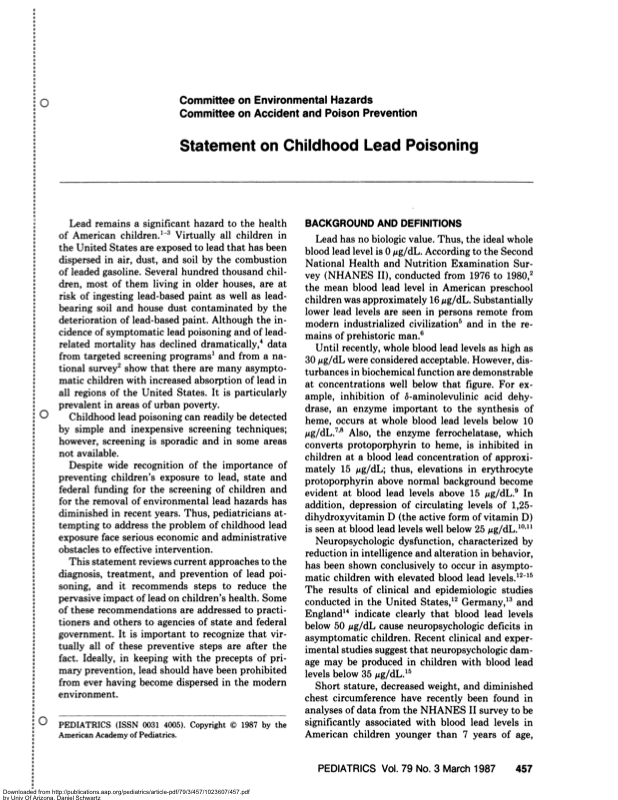 Statement on Childhood Lead Poisoning
 Read more →
American Academy of Pediatrics policy statement on childhood lead poisoning, addressing screening, diagnosis, and treatment recommendations.
BLL Actions
Defines excessive absorption as ≥25 µg/dL with EP ≥35 µg/dL.
Treatment
Utilizes 3–5 days of CaNa2-EDTA to rapidly decrease the mobile, highly toxic fraction of body lead in 25–55 µg/dL range.
Challenge Tests
Relies heavily on lead mobilization test to assess the “mobilizable” pool and determine advisability of full chelation.
Diagnostics
EP is primary screen; requires pre-chelation BUN/creatinine tests to rule out nephrotoxicity risk.
Nutritional Factors
Deficiencies in iron, calcium, and zinc significantly increase gastrointestinal absorption; treating these is a core therapeutic modality.
Environmental Interventions
Complete termination of exposure via thorough wet mopping with high-phosphate detergents and safe paint removal.
Focus/Shift
Emphasizes environmental hazard abatement as the “sine qua non” of intervention, strictly prohibiting children in homes during deleading.
Citation
Committee on Environmental Hazards, American Academy of Pediatrics. Statement on childhood lead poisoning. Pediatrics. 1987;79(3):457-465. doi:10.1542/peds.79.3.457
-
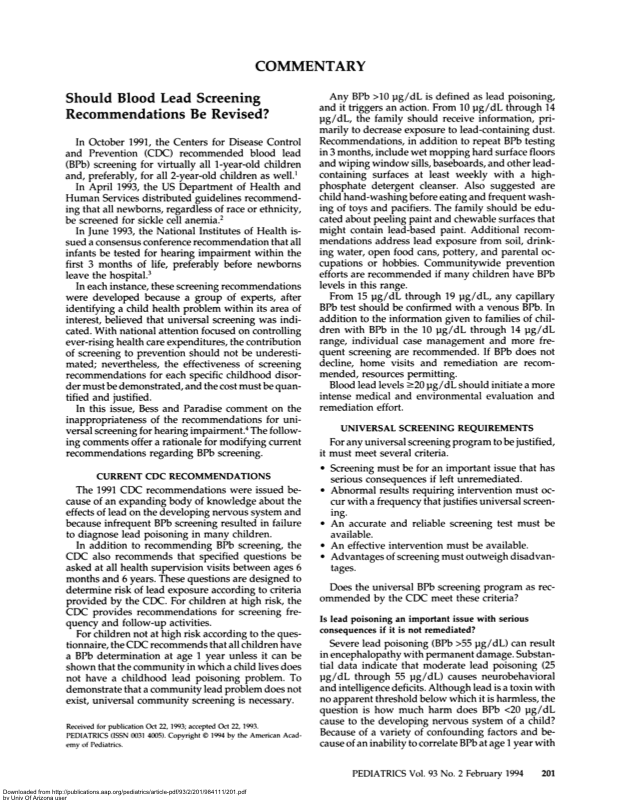 Should Blood Lead Screening Recommendations Be Revised?
 Read more →
AAP committee report evaluating whether universal blood lead screening recommendations should be revised in light of declining prevalence.
Citation
American Academy of Pediatrics, Committee on Environmental Health. Should blood lead screening recommendations be revised? Pediatrics. 1994;93(2):201-204.
-
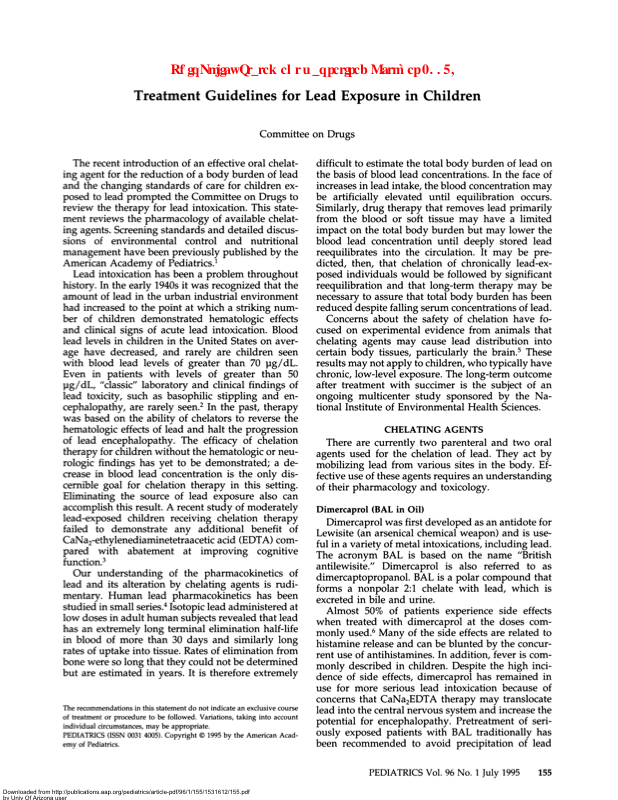 Treatment Guidelines for Lead Exposure in Children
 Read more →
AAP clinical guidelines for the treatment of lead exposure in children, including chelation therapy thresholds and management protocols.
BLL Actions
BLL <25 µg/dL requires aggressive environmental intervention; 45–70 µg/dL indicates succimer or CaNa2EDTA.
Treatment
Recommends oral succimer (30 mg/kg/day); explicitly warns against using CaNa2EDTA alone for encephalopathy.
Challenge Tests
EDTA mobilization test explicitly deemed obsolete due to technical difficulty, expense, and potential toxicity.
Diagnostics
Requires G-6-PD deficiency screening before BAL to prevent severe hemolysis; abdominal X-rays detect enteral lead.
Nutritional Factors
Medicinal iron strictly contraindicated during BAL; zinc supplementation potentially beneficial during long-term CaNa2EDTA.
Environmental Interventions
Bowel decontamination considered an adjunct if enteral lead is visible on radiographs.
Focus/Shift
Emphasizes chelation lacks proven cognitive benefits for low-level exposure; eliminating environmental sources is the only discernible goal.
Citation
American Academy of Pediatrics, Committee on Drugs. Treatment guidelines for lead exposure in children. Pediatrics. 1995;96(1):155-160.
-
 Screening for Elevated Blood Lead Levels
 Read more →
AAP Committee on Environmental Health policy statement updating screening recommendations for elevated blood lead levels in children.
Citation
American Academy of Pediatrics, Committee on Environmental Health. Screening for elevated blood lead levels. Pediatrics. 1998;101(6):1072-1078.
-
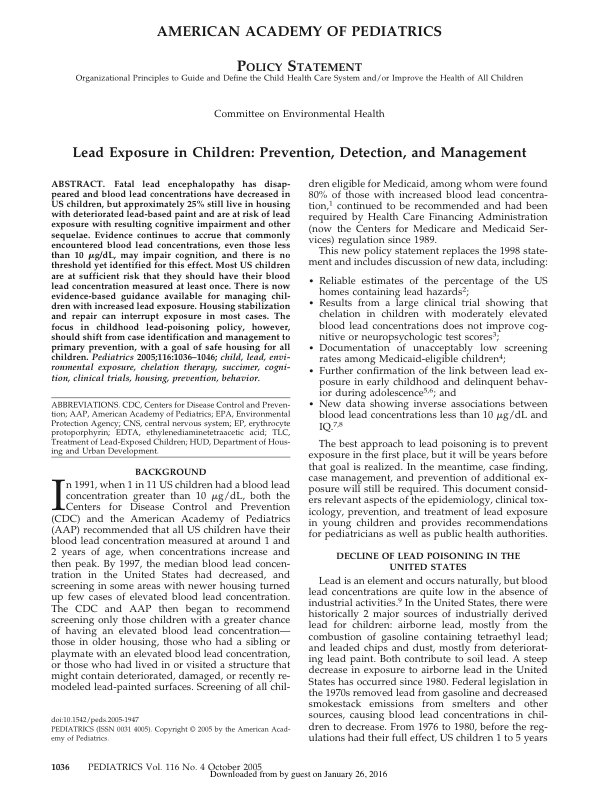 Lead Exposure in Children: Prevention, Detection, and Management
 Read more →
AAP clinical report on the prevention, detection, and management of lead exposure in children, updating pediatric practice recommendations.
BLL Actions
Reaffirms 10 µg/dL as the level of concern but acknowledges IQ drops steeply at <10 µg/dL.
Treatment
Confirms Treatment of Lead-Exposed Children (TLC) trial proves succimer for 20–44 µg/dL does not improve cognitive/neuropsychologic scores.
Challenge Tests
Reaffirms EDTA challenge test is entirely obsolete.
Diagnostics
Shifts toward targeted screening based on local prevalence, though Medicaid children still require universal screening.
Nutritional Factors
Notes no trial data support dietary interventions specifically modulating lead effects, but adequate calcium/iron/vitamin C remain vital.
Environmental Interventions
Highlights that moving children to unleaded homes during abatement is crucial to prevent acute BLL spikes.
Focus/Shift
Notes case-finding alone will not decrease risk; demands integrated housing and public health activities.
Citation
American Academy of Pediatrics, Committee on Environmental Health. Lead exposure in children: prevention, detection, and management. Pediatrics. 2005;116(4):1036-1046. doi:10.1542/peds.2005-1947
-
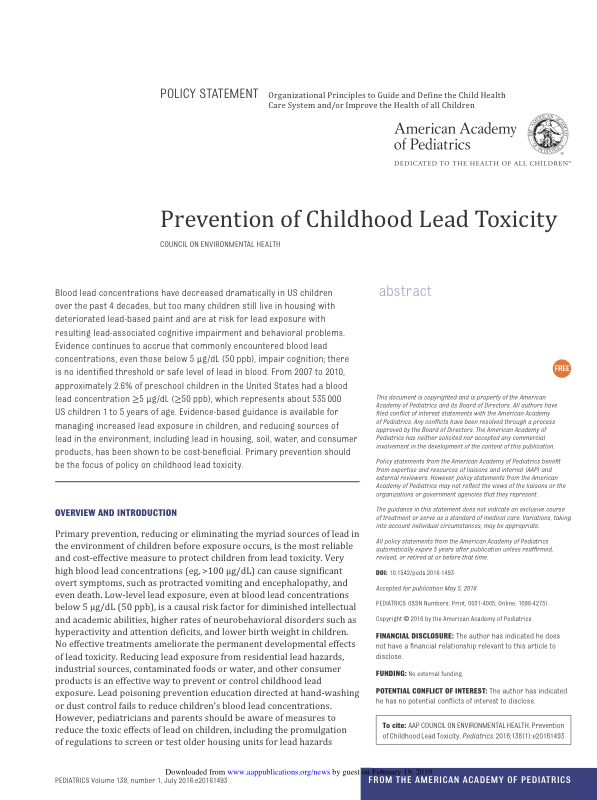 Prevention of Childhood Lead Toxicity
 Read more →
AAP policy statement on preventing childhood lead toxicity, endorsing the CDC reference value and calling for stronger regulatory and public health action.
BLL Actions
Adopts CDC reference value of ≥5 µg/dL for case management; notes irreversible cognitive deficits occur <5 µg/dL.
Treatment
Acknowledges no effective medical treatments ameliorate permanent developmental effects.
Diagnostics
Advocates reducing allowable lab error to ±1 µg/dL for BLLs ≤20 µg/dL when feasible.
Screening
Urges testing of immigrant, refugee, and internationally adopted children upon arrival in the US.
Nutritional Factors
Screen for iron sufficiency using complete blood cell count, ferritin, and C-reactive protein.
Environmental Interventions
Recommends EPA/HUD revise downward the allowable levels of lead in house dust, soil, paint, and water.
Regulation
Notes EPA water action level (15 ppb) is not health-based and fails to protect children/pregnant women.
Focus/Shift
Calls for strict, empirically-based legal standards regulating allowable lead across all consumer products and environmental media.
Citation
American Academy of Pediatrics, Council on Environmental Health. Prevention of childhood lead toxicity. Pediatrics. 2016;138(1):e20161493. doi:10.1542/peds.2016-1493