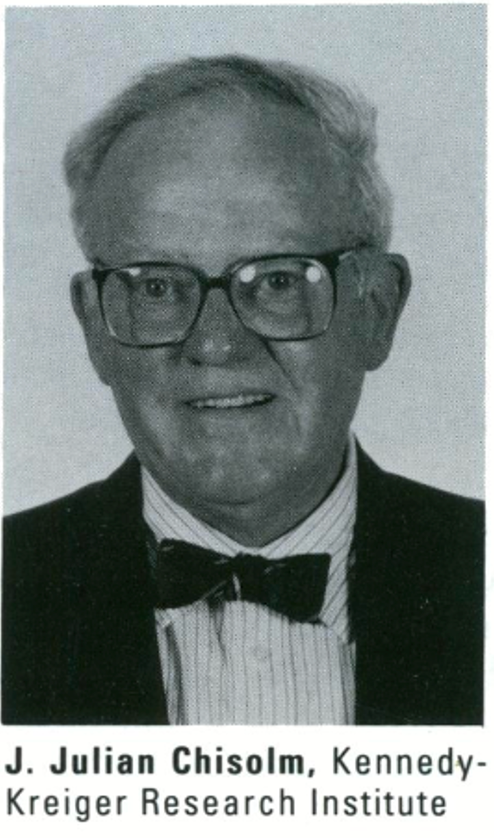
 FILE NO. TLC-PI-BAL
 J. Julian Chisolm Jr. , MD
Principal Investigator, Baltimore Clinical Center — Kennedy Krieger Institute
- Site
- Baltimore
- Affiliation
- Kennedy Krieger Institute, Baltimore
- TLC era
- 1990s
- Tags
- Principal InvestigatorLead ToxicologyBAL+EDTAKennedy KriegerSteering Committee
Born July 24, 1921, in Baltimore to a medical family — his great-grandfather Julian John Chisolm was a Confederate surgeon, author of the Manual of Military Surgery, and later Dean of the University of Maryland Medical School. Princeton (chemistry, 1944), Johns Hopkins School of Medicine (MD, 1946), then Army Medical Corps captain in Germany before returning to Hopkins pediatrics.
Working with Harold E. Harrison at Baltimore City Hospitals and Hopkins in the 1950s–60s, Chisolm championed combined parenteral BAL + CaNa₂EDTA therapy for acute lead encephalopathy. His protocol — deep IM BAL+EDTA injections every four hours for 5–7 days — roughly doubled urinary lead excretion versus EDTA alone. By the late 1960s his regimen had reduced acute encephalopathy mortality from ~65% to under 2%.
In 1975 he became director of the lead program at the Kennedy Institute (later Kennedy Krieger Institute), a position he held until retirement in 2000. His 1992 review documented that succimer dropped blood lead from ~38 µg/dL to ~11 µg/dL within three weeks but rebounded to ~70% of pretreatment values once treatment ended — because up to 70% of total body lead burden is sequestered in bone and cannot be reached by chelation.
These physiological observations anchored his clinical philosophy. As early as his 1971 Pediatrics paper, he established what became the foundational rule: "No child is ever returned to a leaded house." By the 1990s he viewed medical treatment as "unequivocally secondary to environmental eradication." He died on June 22, 2001 — four days after the Maryland Court of Appeals ruling in Grimes v. KKI.
Submitted the original Technical Plan to NIEHS on November 23, 1992, in response to RFP NIH-ES-92-31. KKI Principal Investigator and member of the TLC Steering Committee.
Chisolm's prior clinical studies of DMSA at Kennedy Krieger were part of the FDA submission supporting the drug's approval. The 26-day dosing protocol — 1050 mg/m²/day for 5 days followed by 700 mg/m²/day for 21 days — was adopted by TLC.
On January 25, 1993, Chisolm wrote to Thomas R. Hendrix (Chair, JHU School of Medicine IRB) noting that DMSA "is considered investigational" at lower blood lead levels and that "in my view, the outcome of this study will not be determined by a single course of DMSA, but, rather, by the ability to suppress lead-bearing dust in the home over the long run."
- 1946 MD, Johns Hopkins School of Medicine
- 1956 Co-authored "The Exposure of Children to Lead" with Harrison
- 1968 Landmark chelation paper — mortality from encephalopathy drops to <2%
- 1971 "No child is ever returned to a leaded house" — Pediatrics
- 1975 Director, Lead Program at the Kennedy Institute
- 1992 Submitted original TLC Technical Plan to NIEHS
- 1994 TLC enrollment begins at Baltimore site
- 2001 Senior author, TLC primary publication; died June 22 — 4 days after Grimes ruling
“No child is ever returned to a leaded house.”
“In my view, the outcome of this study will not be determined by a single course of DMSA, but, rather, by the ability to suppress lead-bearing dust in the home over the long run.”